Smart Switches Without a Neutral Wire: What Works in Indian Switchboards
Many Indian switch boxes carry only the live and the switched live, with no neutral. Learn what a neutral does, the options when it is missing, why LEDs flicker or glow, and what to check before you quote.
By Abhi Bavishi, Founder, Smartify
Technical review pending
At a glance
You will learn
- What a neutral does and why many switch boxes have none
- Your options when a box has no neutral
- Why LEDs flicker or glow, and how to test before handover
You need
- An electrician for any mains work
- Your survey notes
Key takeaway
Do not order modules until an electrician has checked every box you want to change.
Key terms in this lesson (8)
- Bypass
- A part wired in parallel with the load that some live-only modules need to control small LED loads. Use only the part the maker supplies for that exact module.
- Distribution board
- The board where the home's circuits are fed and protected, each by its own MCB.
- Ghosting
- Flicker, a faint glow or flashing from an LED lamp that is switched off, usually because a live-only module leaks standby current through it.
- Live-only module
- A switch or relay module that needs no neutral. It takes its standby power through the load, so it has a minimum load, and some LED lamps flicker or glow with it.
- MCB
- Miniature circuit breaker, the protection device for one circuit on the distribution board. Isolate a circuit at its MCB, not just at the wall switch.
- Minimum load
- The smallest load a live-only module will drive reliably, stated by its maker. Below it, lamps can flicker or glow.
- Neutral
- The wire that gives current its return path to the supply. A smart switch needs one in its box, because its radio and small power supply must stay alive when the light is off.
- Switch loop
- A wiring arrangement where the live goes to the switch box and a switched live goes on to the light, while the neutral runs from the supply straight to the light and never enters the box. A mechanical switch works fine this way; a smart one does not.
Short answer: have an electrician inspect every box before ordering modules. Without neutral at the switch, choose between adding it, locating the relay where that circuit has neutral, a compatible live-only module, or smart bulbs with wireless buttons.
A smart switch needs power for its radio even when the lamp is off. The wiring and the actual lamps decide which approach works.
Safety first
Mains work is for a qualified electrician. Isolate at the circuit’s MCB, not just the wall switch, and test dead before unscrewing anything. Never identify neutral by colour alone, remove earth or bypass protection. Follow the maker’s diagram and applicable local wiring rules. Stop if conductor identity is uncertain.
What a neutral does, and why your box may not have one
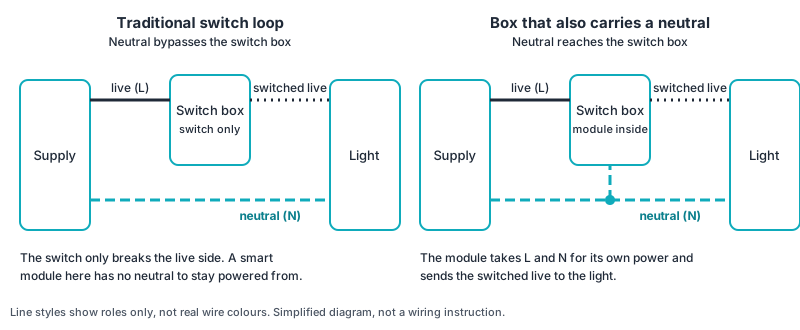
Current reaches a lamp on live and returns on neutral. A mechanical switch only breaks live. In a switch loop, live reaches the box and switched live returns to the lamp; neutral goes directly to the fitting. One practitioner guide describes this as common in Indian switch boxes, not a measured national survey.
A neutral-powered module needs live and neutral for its electronics. A live-only module uses the load path instead, with limitations described below.
Find out what you have
- With the circuit isolated, ask the electrician to identify live, switched live and neutral. Two conductors per switch suggest a switch loop, but do not prove conductor identity.
- Check whether the same circuit has neutral at the ceiling/fan point or distribution board.
- Check conduit capacity for another conductor and whether wall opening would be needed.
- Measure every box and photograph wiring before disturbing it. Rooms wired at different times can differ.
Your options
| Option | Neutral required | Main check |
|---|---|---|
| Replacement on/off smart switch | At box, unless live-only | Plate fit, rating and datasheet load rules |
| Relay behind existing switch | At box, unless live-only | Depth, conductors and switch-input behaviour |
| Neutral-powered dimmer | At box | Dimmable lamps, compatibility and minimum load |
| Live-only module | No | Actual lamps, minimum load and specified bypass |
| Relay at fitting | At that point | Safe installation and wired/wireless control path |
| Distribution-board module | At board | Whole-circuit rating and space |
| Smart bulb plus wireless button | No switch-box work | Wall switch must remain on |
Neutral-powered on/off modules do not rely on the lamp for standby power, but all module types still need their datasheet checks. Fans and pumps need modules rated for motor loads. A relay behind a plate may keep the familiar mechanical switch as its input; verify the actual wiring and setup.
Live-only modules: how they work, and where they fail
A live-only module draws standby current through the lamp even when “off”. Incandescent lamps tolerate this better than LED/CFL drivers, where accumulating leakage can cause glow or flashing, often called ghosting.
Check minimum load against the actual lamp combination. One maker specifies a parallel bypass for its LED arrangement, with lamps above 5 W; that number belongs to that model, not every module. Several lamps may behave differently from a single small LED.
Use only the maker’s bypass/accessory for that exact model, installed to its diagram. Never improvise capacitors or resistors. A neutral-powered module avoids load-derived standby current, but dimmers can still impose minimum-load and compatible-lamp rules. Do not promise “any LED”: agree to test the fitted lamps and explain the remedy if they misbehave.
Bringing a neutral to the box
Adding neutral can broaden module choice where conduit allows. It must come from the same circuit as live. Borrowing another circuit’s neutral can cause RCD/RCBO tripping because outgoing and returning currents do not pass through the same protection path.
Do not crowd full conduit. Agree any wall chasing, repairs and cost before work begins. Adding neutral removes the standby-current-through-lamp problem, not every datasheet restriction.
Depth and space in the box
Shallow boxes may need replacement, a thinner compatible module or a relay at the fitting. Allow conductor bend room and avoid terminal strain. Check operating-temperature limits behind the closed plate rather than forcing a module into available space.
Test before handover
Test each fitted lamp type for off-state glow in darkness. Operate wall switch and app in every combination, checking state synchronisation. Have the electrician cut and restore circuit power; record off/on/previous restore behaviour. Test the promised wall control with hub and internet off. Record neutral availability, module and lamp type per box.
Red flags
Stop for borrowed neutrals, removed earths or defeated MCB/RCCB protection. Do not proceed with unidentified conductors, an “any LED” promise, or a quote that omits box depth, conduit capacity and finishing work.
Where to go next
Check yourself.
Questions from real jobs. Think first, open the answer, then say how you did. The score is for you and stays on this device.
A switch box has only two conductors per switch: one in, one out to the light. What does that suggest, and who confirms it?
It is the classic sign of a switch loop with no neutral in the box. Only the electrician can confirm what each conductor is, with the circuit isolated.
A client wants any LED to work with a live-only module. What do you say?
Do not promise it. Live-only modules have a minimum load. Say you will test the lamps actually installed and tell them what you will do if one misbehaves.